What's the Difference, in Short?
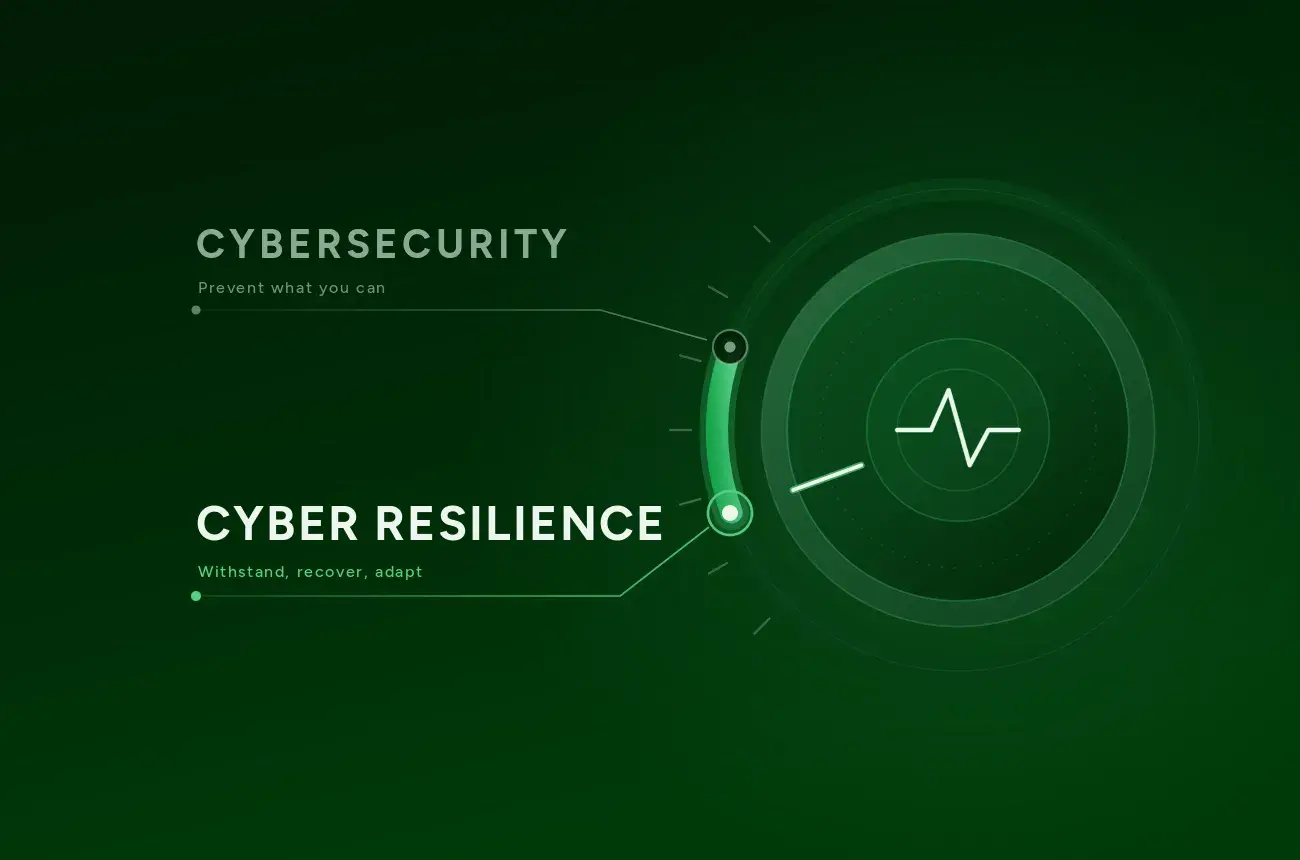
Cybersecurity and cyber resilience are related but not interchangeable. Cybersecurity focuses on preventing attacks from succeeding. Cyber resilience focuses on what happens when prevention fails anyway: whether operations keep running and how fast they recover.
What Is Cybersecurity?
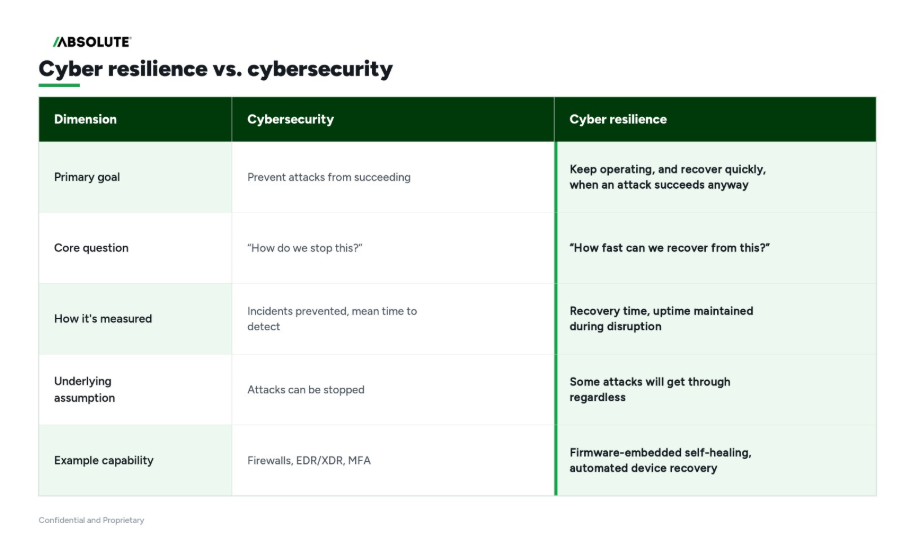
Cybersecurity is the practice of protecting systems, networks, and data from unauthorized access, disruption, or damage, built around layered preventive and detective controls — firewalls, EDR, identity and access management, vulnerability management. Its core assumption is that with the right controls, most attacks can be stopped, and its metrics reflect that: incidents blocked, mean time to detect, vulnerabilities remediated. What it doesn't natively measure is what happens when prevention fails anyway — historically not considered the discipline's job, which is the gap cyber resilience picked up.
What Is Cyber Resilience?
Cyber resilience is an organization's ability to anticipate, withstand, recover from, and adapt to cyberattacks, not just prevent them, per NIST Special Publication 800-160, Volume 2. For the full four-stage breakdown, see What Is Cyber Resilience? A Clear Definition for Security Leaders.
Why the Difference Matters
Security controls fail to keep devices in a protected, enforceable state roughly one-fifth of the time, per Absolute's 2026 Resilience Risk Index. An organization that only tracks prevention metrics can look successful right up until one incident exposes how slow its recovery actually is — which is why boards are starting to ask for recovery metrics alongside prevention metrics directly.
How the Two Disciplines Differ in Practice
- Different tools, different purpose — prevention tooling vs. restorative tooling (firmware-embedded persistence, automated recovery).
- Different budget conversations — risk-reduction framing vs. downtime-cost framing, often different parts of the budgeting process entirely.
- Different skills on the team — threat detection/IR vs. IT ops recovery automation + business continuity planning.
- Different metrics reported upward — incidents blocked vs. MTTR and fleet-wide automated recovery coverage.
- Different incident response playbooks — prevention-only playbooks end at containment/forensics; resilience playbooks continue through an explicit, owned recovery phase with its own time target.
A Side-by-Side Scenario: Responding to the Same Phishing Attack
Same incident, two outcomes. Prevention-only: contain, investigate, then manual reimage — employee down a day to a week. Resilient: containment plus firmware-level self-healing triggers automated restoration — fully compliant device back in a fraction of the time, no shipping, no manual reimage. The attack is identical; the variable is which stage the organization invested in.
The same gap shows up at ransomware scale, too
Swap phishing for a ransomware incident hitting a few hundred endpoints at once, and the gap stops being days and becomes weeks. Prevention-only: manually reimaging hundreds of devices one at a time — bottlenecked by physical access, not headcount. Resilient: automated recovery triggers across the entire affected fleet simultaneously, no technician touching any device individually — hours instead of weeks. The attack's severity is identical; the recovery architecture determines how long the business actually feels it.
Why You Need Both, Not One or the Other
Cybersecurity is foundational to resilience, not an alternative. See The Missing Link in Cybersecurity: Why Cyber Resilience Matters and Moving Beyond Defense: A Resilient CISO's Guide. Absolute's approach is outlined on the Autonomous Cyber Resilience platform page and in The Real Cost of Downtime. Historically cybersecurity came first; resilience is the newer "second half" the probabilistic reality of modern attacks forced into existence.
Which Should You Invest In First?
Mature prevention, no recovery automation → invest in resilience next. Neither discipline mature → prevention first, since under-protection generates too much volume for any recovery process to keep up with. Sequence: reasonable prevention baseline, then shift incremental spend to recovery automation rather than chasing marginal prevention gains. A simple pressure test: ask what the organization's actual recovery time would be if its best-defended system were compromised tomorrow — if nobody can answer with a number, the budget is likely still weighted toward prevention by default rather than by deliberate decision.
Common Misconceptions About Cyber Resilience vs. Cybersecurity
- "It's just a rebrand of cybersecurity" — no; the two measure different things and an org can excel at one while weak in the other.
- "Good enough prevention means we don't need resilience" — Gartner: "CISOs are still in a prevention mentality. You must transition to a resilience mentality."
- "Resilience only matters after a breach" — it has to be built and tested beforehand.
- "It's only IT/security's job" — genuinely cross-functional (security, IT ops, business continuity, executive leadership).
How Analysts and Regulators Are Framing the Shift
Gartner's research frames this as shifting board/C-suite investment from prevention-only toward response and recovery. The SEC's cybersecurity disclosure rules reinforce it from the regulatory side, asking public companies to describe ongoing risk-management processes, not just breach occurrence.
A Simple Way to Assess Where Your Organization Stands
Plot prevention maturity and recovery maturity as two separate axes. Strong prevention/weak recovery looks secure but faces long, costly outages when something does get through. Weak in both compounds fast. The target, strong in both, is what resilience as a discipline pushes toward.
The Historical Context: Why Resilience Is the Newer Discipline
Cybersecurity predates resilience by decades, built on the assumption that enough prevention could make successful attacks a rare exception. Ransomware, supply chain attacks, and incidents with no attacker at all (like CrowdStrike) broke that assumption publicly, and NIST's four-stage model and Gartner's resilience research both represent standards bodies and analysts independently concluding recovery needed to be its own discipline.
Conclusion
Cybersecurity and cyber resilience aren't competing strategies — they're two halves of the same job, one reducing how often something goes wrong, the other determining how fast you bounce back when it does anyway. Security programs that measure both, rather than treating prevention as the whole mandate, are the ones best positioned for the incident prevention doesn't catch.

FAQs
Cyber resilience builds on cybersecurity rather than replacing it. Cybersecurity supplies the prevention layer; resilience adds the ability to keep operating and recover quickly when that prevention doesn't hold. Neither one is complete without the other.
You reduce the odds of an incident but have no plan for when one succeeds anyway. Recovery ends up improvised: manual remediation, physical device access, and extended downtime, often lasting days rather than minutes
Cybersecurity is typically measured in incidents prevented and mean time to detect. Cyber resilience is measured in recovery time and how much operational capability is maintained during a disruption.
A preventive control blocks a phishing email or isolates a compromised endpoint. A resilient response goes further: it automatically restores that endpoint's security controls and applications to a known-good state, without a technician physically touching the device.