

The Question Every Environment Eventually Faces
Imagine your environment gets hit tonight, ransomware, a bad patch, doesn't matter which. You need to minimize business disruption and get systems and operations back up fast, with as little impact as possible. How do you actually do that?
For a lot of vendors, the honest answer is: not as fast as they claim. They'll tell you the response is autonomous. What's often running underneath is automation, a workflow that still needs a person to ask the right question before anything moves. That gap between the label and what's actually happening is where effectiveness gets left on the table.
There's a moment in almost every conversation about IT and cybersecurity automation where the words start to blur together. Automated. Autonomous. Agentic. AI-powered. They get used interchangeably, often in the same sentence, and the customer on the other end is left to guess what they're actually buying. That confusion isn't harmless: it tends to surface at the worst possible time, during an incident, not during a demo.
This isn't just a vendor problem, either. Some providers dress up basic rule-based automation as AI agents just to keep pace. Researchers have a name for it: agent washing. The result is a gap between tomorrow's vision of full autonomy and the more limited, trigger-and-response systems most agents actually deliver today.
The Problem Isn't the Technology. It's the Vocabulary.
Most organizations are past the point of asking whether automation belongs in their environment. The real question now is which decisions are safe to hand off, and under what conditions. That's a governance question, not a technology question, and it depends on two things: how critical a system is to the business, and how confident you can be that an action will succeed.
Consider patch management. A vulnerability in a browser extension and a vulnerability in a core business application don't carry the same risk profile, even when both score the same on a CVE. The browser extension might have a resilient fallback, a different browser, a web version of the same tool, that makes a failed patch a minor inconvenience. The core application might not. Business criticality, not just technical severity, has to shape how much autonomy is appropriate for a given action. [Ed: internal link opportunity — link to Secure Endpoint or patch/vulnerability management page]
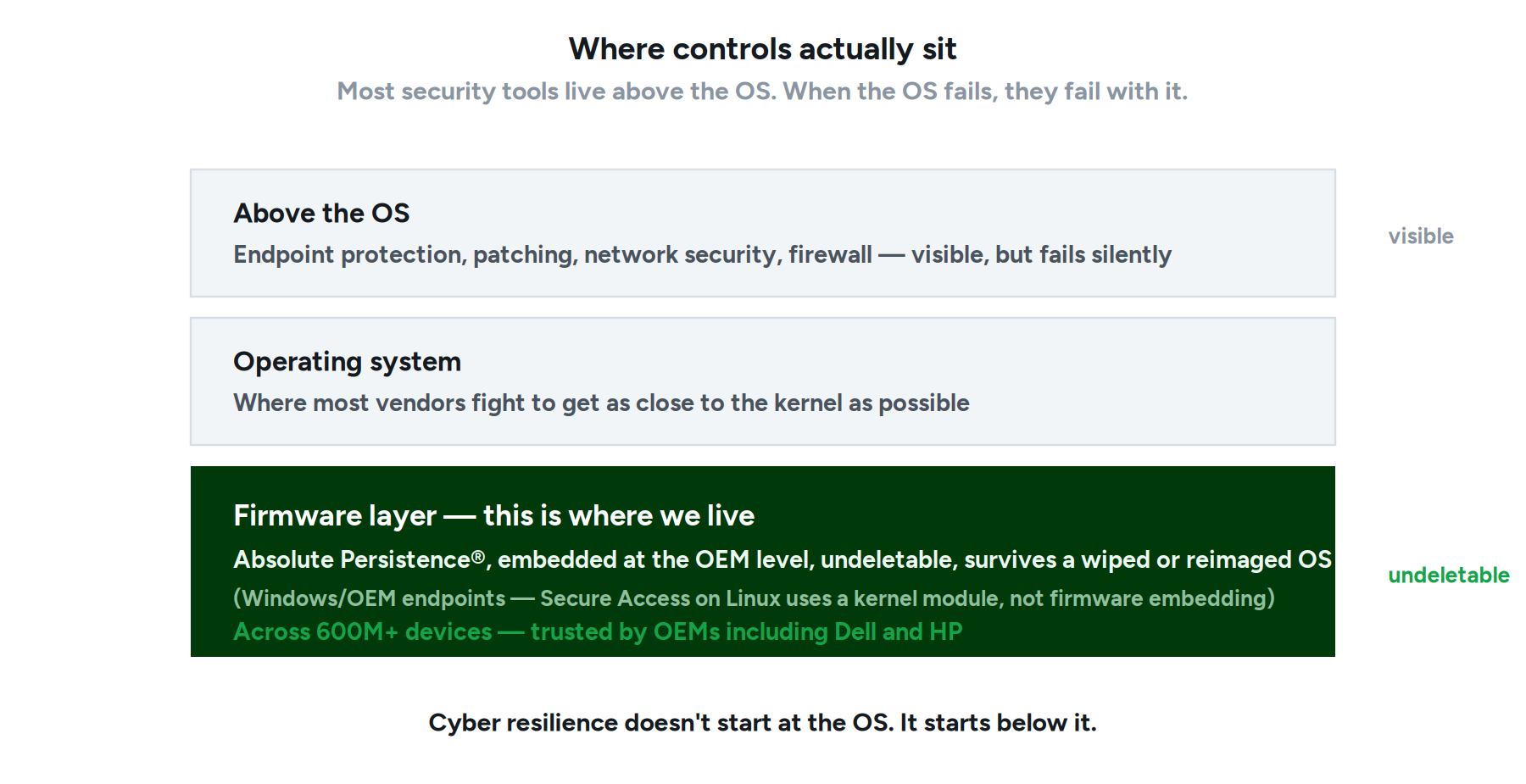
That's the axis most vendors leave out of the conversation. They talk about capability. They rarely talk about where that capability actually sits, or what happens to it when the OS itself is the thing that fails.
A Working Definition, in Three Tiers
Once criticality and confidence are on the table, the language gets easier to sort out. Here's the distinction we hold ourselves to internally:
The distinction that matters most is in that last column. Automation still depends on a person deciding what should happen and when. Autonomy means the system recognizes something needs attention and acts on it, without waiting to be told.
A system only earns the word "autonomous" if it's self-triggered, involves zero manual steps, and can actually be demonstrated doing that live. Anything short of that is automation wearing a more exciting name.
Gartner Draws the Same Distinction
According to Gartner® analyst Don Scheibenreif, “autonomy is the next major shift beyond AI itself, systems that sense what’s happening and act independently, without waiting on human instructions.” Gartner also predicts that, “By 2030, machine customers could drive or influence $18 trillion in purchases. This signals a new era where autonomy — not just automation — sets leading organizations apart.”
Source: Gartner, “Autonomous Business Is Coming, Powered by AI,” Don Scheibenreif, 2026. GARTNER® is a registered trademark and service mark of Gartner, Inc. and/or its affiliates in the U.S. and internationally and is used herein with permission. All rights reserved.
The Organizational Piece Nobody Puts on the Slide
Any conversation about expanding autonomy also has to account for how the people using these systems are actually incentivized. Engineering and IT teams are rarely rewarded for patching faster. They are absolutely held accountable when a patch breaks something. That asymmetry shapes behavior more than any framework does, and it's worth naming directly rather than assuming better tooling alone will change adoption.
The path forward isn't to erase that caution. It's to build enough structure, visibility, and confidence into automated and autonomous actions that teams can trust the safeguards, and can explain to leadership why a slightly more aggressive action was taken when it mattered (an actively exploited vulnerability, for example) versus why routine, low-risk updates can run without a second thought.
Language Integration Is Not an Analysis Engine
This is where the vocabulary problem shows up most clearly. Most of what gets marketed today as AI-driven remediation is a translation layer, Tanium's approach is a clear example: you ask a question in natural language, the system converts it into a query, and a person still has to know what to ask in the first place. That's a workflow built around answering the question you give it. It's not the same thing as a system that infers which question needs asking and investigates on its own.
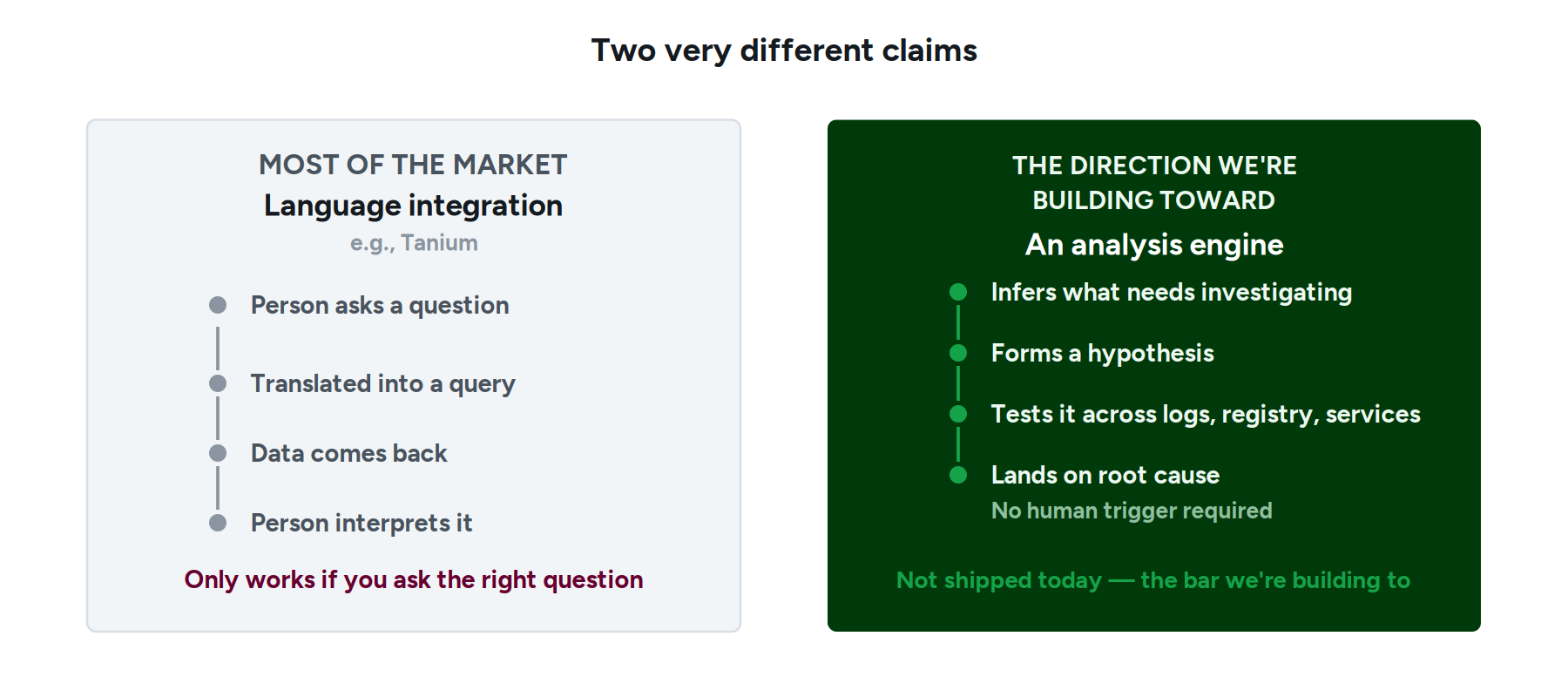
That's the difference between a language interface and an analysis engine, one that answers the question you haven't asked yet, rather than just the one you did. We're building toward exactly that kind of system, and we'll hold ourselves to the same bar we laid out above (self-triggered, zero manual steps, demoable live) before we call any of it autonomous.
"The industry doesn't need another vendor claiming autonomy. It needs vendors willing to define exactly what they mean by it, and hold that definition to a standard that can be demonstrated, not just described."
Getting Specific About What We Mean
We're not going to pretend "autonomous" is a settled term. But we think it should mean something specific: self-triggered, zero manual steps, demonstrable live. Everything we build gets held to that bar before we use the word, whether it's how we talk about the Autonomous Cyber Resilience Platform or how we talk about a single feature. [Ed: internal link opportunity — link to the Autonomous Cyber Resilience Platform product page]
That's the bar worth setting, for us and for everyone else using these words.
See the difference between automation and true autonomy in action. Request a demo.
Absolute Persistence® and the Autonomous Cyber Resilience Platform are trademarks of Absolute Software Corporation.