When Security Agents Fail, Attackers Win



The problem
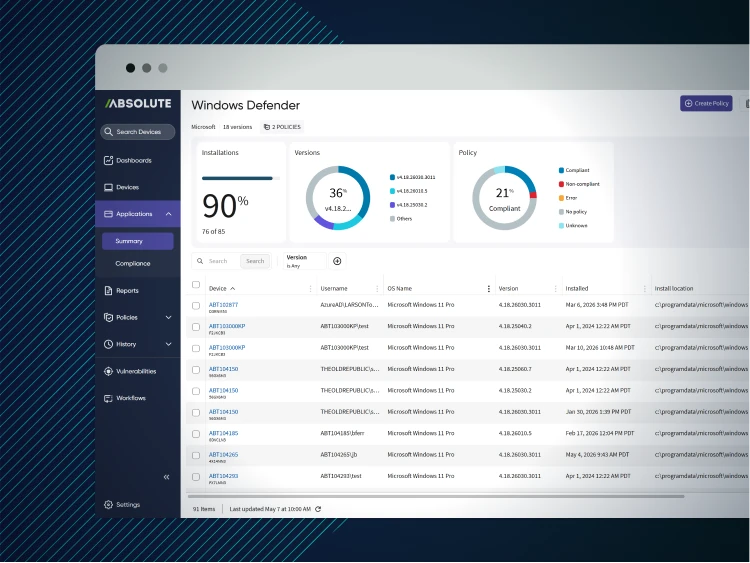
Security tools rarely fail dramatically. They fail quietly.
An EDR agent stops reporting after an update. A VPN client is disabled to fix a connection issue. A management agent crashes and never restarts. These everyday failures rarely trigger alarms—but they leave endpoints unprotected.
Most organizations assume their security stack is working. In reality, some of their most important controls have already stopped.
Silent control failures create real exposure
Security teams often discover broken agents only after an incident investigation. By then, attackers may have had weeks of unrestricted access.
Silent control failures slowly erode your security posture, one endpoint at a time, until a single compromised device becomes an unprotected entry point for bad actors.

Managing our diverse IT environment across such a large institution required real-time visibility and effective control of all endpoints. Absolute proved to be an ideal solution.
Turn fragile security tools into resilient controls
Stop chasing broken agents after they fail. Build a security posture that repairs itself. Absolute Secure Endpoint uses a patented firmware-embedded persistence layer to continuously monitor the health of critical security and business applications. If a security agent is disabled, corrupted, or removed, it is automatically restored; without user intervention.
Instead of hoping your controls are active, you can verify that they are.
See self-healing security in action
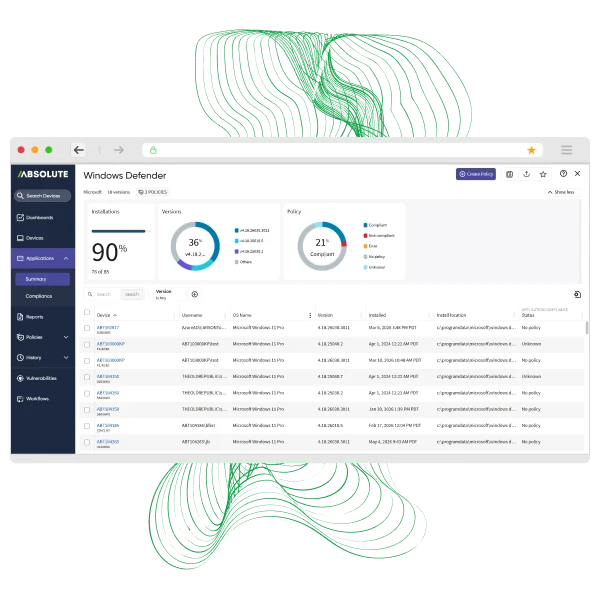
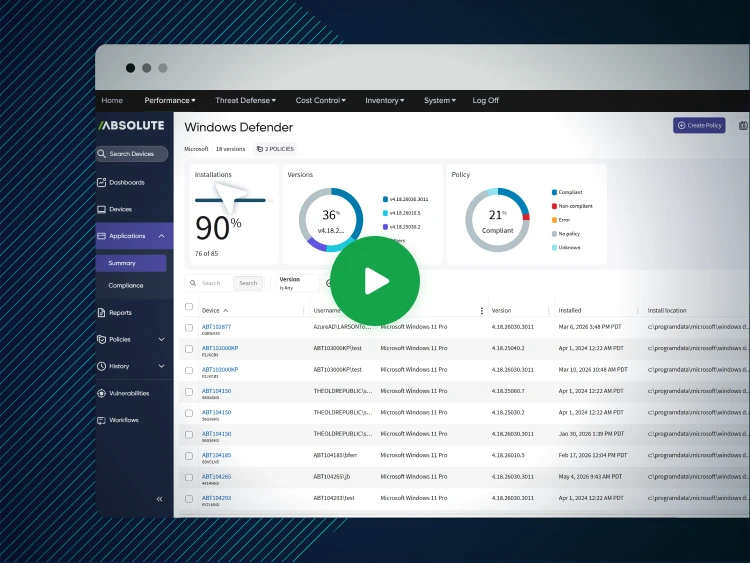
Watch how Absolute detects failed agents, restores critical security controls, and verifies enforcement across distributed endpoints.
- Detect security agent failures instantly
- Automatically self-heal tampered applications
- Verify protection across remote devices


BW Offshore secures global endpoint resilience
Operating across offshore locations and distributed teams, BW Offshore needed continuous visibility and reliable endpoint protection.
With Absolute self-healing technology, the company restored visibility across its global fleet and ensured mission-critical applications remained operational.
- Fleetwide Visibility Anywhere
Offline devices were surfaced and brought back under management. - Automated Application Recovery
Security and business tools were automatically restored after failure. - Reduced Operational Overhead
IT teams spent less time troubleshooting broken agents.
Key capabilities for non-stop security controls

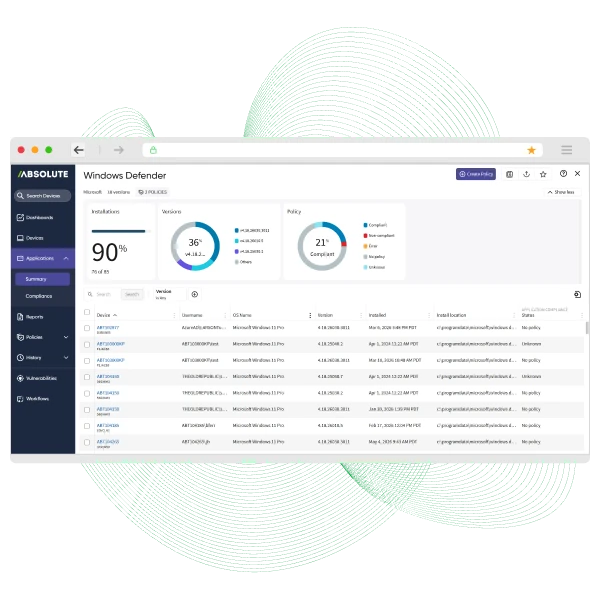
Continuously track the status and performance of critical business and security applications with real-time alerts when failures or tampering occur.

Automatically restart, repair, or reinstall critical agents including EDR, EPP, UEM, VPN, and SSE when failures or tampering are detected.

Generate detailed logs and reports proving applications are active and compliant, delivering clear evidence for audits and policy validation.

Eliminate manual remediation by automating monitoring and recovery of security applications across distributed endpoints.
The hidden risk of failing security controls
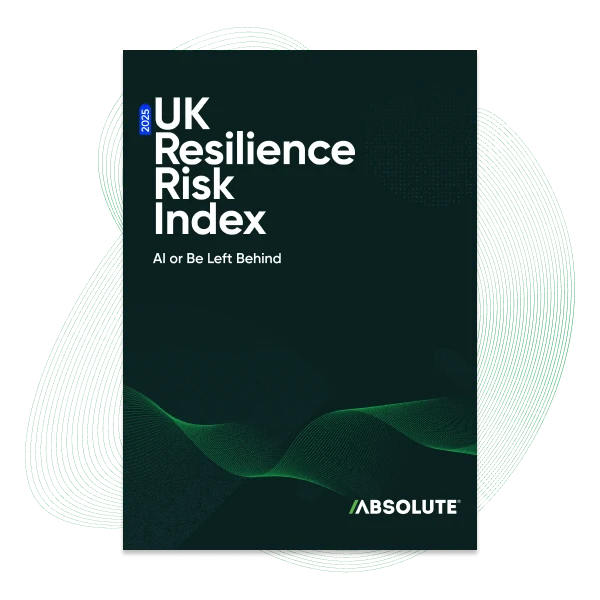
The 2025 Resilience Risk Index exposes a hard truth: many enterprise security controls fail silently. Even well-funded security programs lose visibility when agents stop reporting or critical tools break.
Based on insights from global security leaders, the report reveals where resilience breaks down—and how organizations are closing those gaps.
Inside the report:
- Why security controls stop working 22% of the time
- How silent failures create breach conditions
- Why persistence changes the security model
Take control (for real this time)
Your security stack might look healthy, but broken agents and failed controls hide everywhere. In a free trial of Resilience for Automation, discover how automated enforcement detects failures and repairs them before they create exposure.
- Detect silent control failures: Identify agents that stopped working.
- Automatically restore protection: Repair security tools without IT intervention.
- Reduce operational overhead: Replace manual remediation with automation.

Featured resources for self-healing security
FAQ: Your self-healing security questions answered
Most tamper protection is software-based, meaning it can be bypassed or disabled if the agent itself is compromised or removed. Our resilience is anchored in the device firmware, creating an undeletable connection that operates independently. Even if the OS is wiped, we can reinstall your critical agents and restore your security posture. It's the difference between a lock on the door and a foundation that can't be moved.
We support a broad ecosystem of mission-critical security and management applications, including leading solutions for Endpoint Detection and Response (EDR), Endpoint Protection Platforms (EPP), Unified Endpoint Management (UEM), VPN clients, and Security Service Edge (SSE) agents. Our library of supported applications is constantly expanding.
Quite the opposite. Self-healing automates the tedious and time-consuming process of manually investigating and remediating failed agents. Instead of creating more helpdesk tickets, it closes them before they are even opened. This frees your IT and security teams to focus on strategic initiatives rather than chasing down broken software on individual devices. Look up your tools in our Application Resilience Catalog.
Our firmware-embedded connection ensures we can communicate with a device as soon as it connects to any network—no VPN required. Policies are enforced, and applications are healed automatically the moment the device powers on and finds an internet connection, eliminating the blind spots created by remote work and disconnected assets.
Yes. We provide detailed, audit-ready reports that show the health status of applications over time, including every instance of automated remediation. This gives you verifiable proof of compliance and demonstrates that your security controls are not just present but consistently enforced.