When AI becomes critical, resilience becomes mandatory.
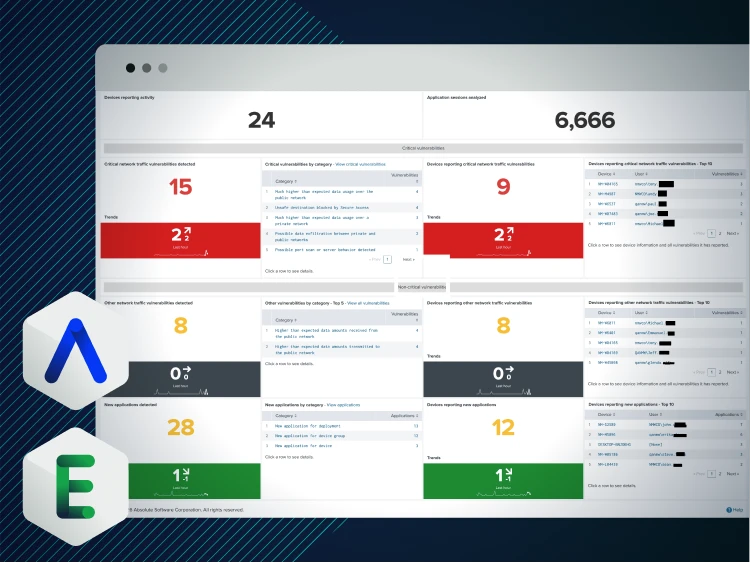



The problem
AI increasingly drives decisions and workflows directly from the endpoint. But when endpoints drift, break, or lose trust, AI doesn’t degrade, it’s removed from use entirely. Without resilience, organizations are forced to shut off AI the moment reliability or recovery can’t be guaranteed.
When trust breaks, critical AI stops
In critical environments, uncertainty isn’t acceptable. When endpoint trust or recovery can’t be verified, AI is pulled from workflows to reduce risk. Diagnostic insights are ignored, releases slow under manual safeguards, and decisions revert to partial data—turning AI from advantage to liability.

We are amazed by the Absolute Persistence® technology. An IT team member took a hard drive out and put it on another machine. The Absolute software agent created itself on the new machine and the old machine with a new hard drive. Indestructible.
Persistent trust for critical AI
Absolute anchors trust, control, and recovery directly to the endpoint—beyond the operating system. When devices are disrupted, rebuilt, or attacked, Absolute automatically restores the conditions AI depends on, so AI workflows remain usable instead of being shut down.
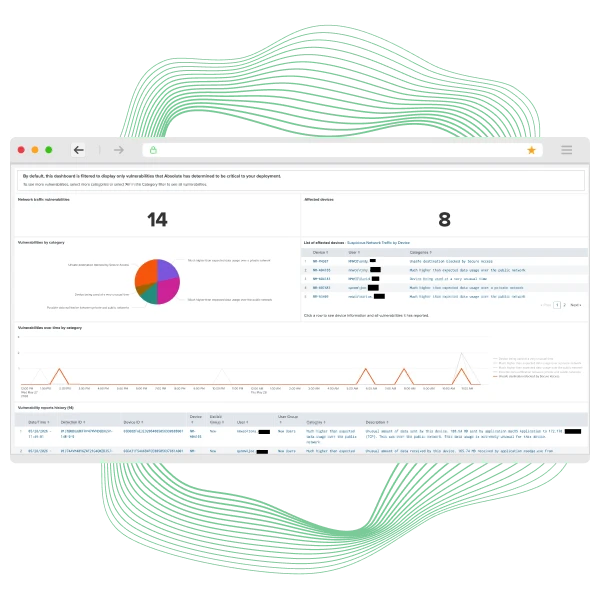
AI resilience that doesn’t rely on best case conditions
See how Absolute keeps AI operational by restoring trust, access, and recovery at the endpoint—automatically and at scale.
- Maintain AI availability during endpoint disruption
- Recover AI workflows without manual rebuilds
- Enforce trusted endpoint state before AI use


Resilience at scale when failure isn’t an option
Operating one of the largest academic environments in the region, UMM Al‑Qura University required uninterrupted access to systems across tens of thousands of endpoints. Endpoint disruption, loss of control, or delayed recovery would have directly impacted operations at scale. By establishing persistent endpoint control and rapid recovery, the university ensured continuity—even when devices failed or were disrupted.
- Maintained control and visibility across a massive, distributed endpoint environment
- Recovered disrupted devices without manual rebuilds or loss of trust
- Established a resilient foundation for future digital transformation initiatives
Key capabilities for resilient critical AI

Ensure AI agents remain present and recoverable on every endpoint.

Verify endpoint state so AI runs only from known, compliant conditions.

Restore AI capabilities automatically after incidents or rebuilds.

Stop silent configuration decay that undermines AI reliability.

Keep secure access to AI‑enabled apps regardless of location or disruption.
Unparalleled persistence for critical outcomes
When AI becomes critical, availability and trust can’t depend on best‑case conditions. This whitepaper explains why resilience is the missing layer in modern security and IT operations—and how firmware‑embedded resilience keeps endpoints, controls, and AI‑driven workflows operational when disruption occurs.
Inside you’ll learn how to
- Why traditional tools fail when endpoints are rebuilt or attacked
- How persistence preserves trust after incidents
- Why recovery speed determines whether AI stays in use
Make critical AI survivable by design
When AI becomes critical, you can’t afford to disable it during disruption. Absolute ensures AI remains available, trusted, and recoverable—so AI continues delivering value when conditions aren’t perfect.
- AI that persists AI remains usable even after endpoint failure or incidents.
- AI you can trust Continuously enforce trusted endpoint conditions behind AI outputs.

Featured resources for managing critical AI
FAQ – Your AI resilience questions answered
Resilience for critical AI means ensuring AI systems remain available, trusted, and recoverable even when endpoints fail, are rebuilt, or are attacked. It focuses on maintaining the endpoint conditions AI depends on—device integrity, configuration, access, and recovery—so AI can continue operating when disruption would otherwise force it offline.
Many AI workflows rely on endpoint‑resident agents, local inference, secure credentials, and device posture. When endpoints drift, lose trust, or are re‑imaged after incidents, those AI dependencies break. Without endpoint resilience, AI becomes fragile—regardless of how advanced the model or platform is.
In critical environments, AI outputs influence real decisions. If endpoint integrity or recovery cannot be verified, organizations disable AI to avoid risk. Untrusted AI introduces uncertainty, compliance exposure, and liability—making it more dangerous than not using AI at all.
No. AI security and governance focus on models, data usage, policies, and behavior. Resilience for critical AI focuses on operational survivability—ensuring AI remains usable and trustworthy after endpoint disruption, configuration drift, or security incidents. It complements AI security but solves a different problem.
Most tools assume endpoints remain intact and agents stay installed. In reality, endpoints are wiped, rebuilt, or tampered with during incidents. When that happens, traditional tools lose control. Persistence addresses this gap by restoring trust and recoverability after failure, not just trying to prevent it.
Without resilience, AI recovery often requires manual endpoint rebuilds, reconfiguration, and validation—delaying restoration and eroding confidence. Persistence dramatically reduces mean time to recovery (MTTR) by automatically restoring the conditions AI depends on, allowing AI workflows to resume faster and more reliably.
No. Any organization using AI for operational decisions—software delivery, customer engagement, fraud detection, forecasting, or automation—faces the same risk. When AI becomes critical to outcomes, resilience becomes mandatory regardless of industry.
No. Absolute Persistence is platform‑agnostic. It supports AI adoption across heterogeneous endpoint, identity, and security stacks by ensuring resilience at the device level. This allows organizations to evolve AI platforms without reintroducing fragility or dependency risk.
In most organizations, AI is disabled until endpoints are rebuilt and trust is re‑established. With Absolute Persistence, endpoints can recover automatically, restoring AI availability and trust faster—so AI workflows resume instead of being abandoned during recovery.
Trust is restored when endpoint state, configuration, access, and controls are verifiably re‑established. Persistence provides the foundation to reassert those conditions automatically, allowing teams to confidently re‑enable AI without guesswork.
The biggest risk is silent failure. AI initiatives appear successful until the first major disruption—when AI is pulled from workflows and never fully returns. Without resilience, AI adoption stalls not because of model performance, but because operational trust can’t be guaranteed.