

Absolute + SentinelOne: Protection That Comes Back
SentinelOne rolls back what attackers change. Absolute brings back what they take down, including the agent itself.
They act at machine speed. We stop downtime.
SentinelOne's Singularity Platform detects, stops, and rolls back attacks at machine speed from inside the OS. Absolute Persistence® sits beneath it in device firmware, so when an attacker disables the agent, the OS is reimaged, or Windows won't boot, protection comes back. The two run at the same time: protection above the OS, resilience below it.
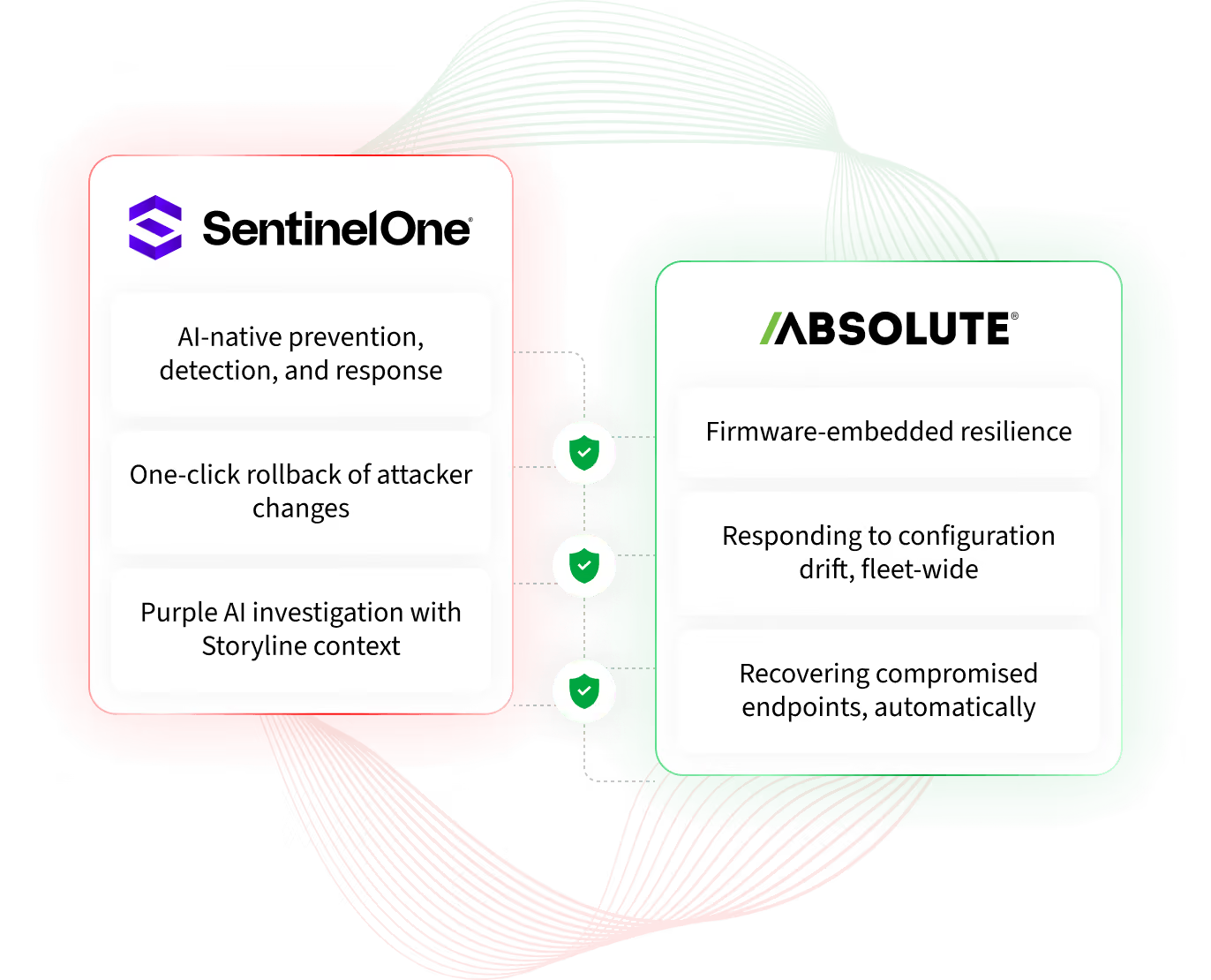
How Absolute and SentinelOne work better together
SentinelOne defends your endpoints at machine speed. Absolute keeps that defense present, healthy, and recoverable, running underneath it in firmware at the same time, not as a backup plan.

If the SentinelOne agent is stopped, removed, or corrupted, Absolute Resilience repairs it or reinstalls a verified copy on supported Windows devices.

Absolute checks the agent's registry entries, files, and services every 15 minutes, so a failing control surfaces before it becomes a blind spot.

Absolute Persistence lives in device firmware, so the connection that restores SentinelOne survives reimaging, drive swaps, and tampering.

Absolute Rehydrate lets IT restore a crashed or compromised device to a trusted state remotely, in minutes, with no truck roll.
Keep SentinelOne running, even when attackers target it
Attackers increasingly disable security agents before they strike. Absolute Resilience monitors the SentinelOne agent from below the OS and repairs or reinstalls it automatically when it's stopped, removed, or corrupted, verifying the installer before each reinstall. On supported Windows devices, visibility returns without anyone touching the device.
Recover in minutes when the OS itself goes down
SentinelOne's rollback undoes an attacker's changes on a running system. When Windows is corrupted or won't boot, Absolute Rehydrate gives IT a remote path back: an admin triggers a playbook that repairs or reimages the device from the firmware up and returns it to a trusted, compliant state in minutes.

Mapped to the Cyber Resilience Framework
Gartner's model for building cyber resilience — anticipate, withstand, recover, and adapt — maps to how SentinelOne and Absolute work, with both contributing to every phase at once.



Anticipate
Behavioral AI and Purple AI surface anomalous endpoint activity so analysts can act before it becomes an incident.

Absolute continuously monitors the health of the SentinelOne agent and other controls, flagging drift or failure before it creates a blind spot.
You see both what attackers are doing and whether your defenses are healthy enough to stop them.
Withstand
AI-native prevention, detection, and response through a single agent stops attacks at machine speed, with decisions made locally.
Absolute Persistence keeps a firmware-level channel to the device that stays available even when attackers go after security tools directly.
An attack that disables the agent becomes a temporary gap, not a lasting blind spot.
Recover
Storyline and Purple AI reconstruct what happened, and one-click rollback undoes attacker changes on a running system.
Absolute Resilience reinstalls the SentinelOne agent if it's removed, and Rehydrate lets IT restore devices whose OS won't boot.
SentinelOne rolls back the attack; Absolute brings back the agent and the device, so recovery doesn't stall.
Adapt
Behavioral AI models are retrained against newly observed attacker tradecraft, so prevention keeps pace with attackers.
Absolute's telemetry gives security and IT teams the fleet-wide data to see what failed, why, and where policy needs to change.
Each incident informs both sides: how attackers operated and which defenses held, so the next response is faster.
Concept per Gartner, “Gartner’s Cyber Resilience Framework: Anticipate, Withstand, Recover and Adapt,” Arthur Sivanathan, Lampis Alevizos, Phillip Shattan, Richard Addiscott, 21 May 2026, ID G00843075. GARTNER is a registered trademark and service mark of Gartner, Inc. and/or its affiliates in the U.S. and internationally and is used herein with permission. All rights reserved.
An attacker disables SentinelOne. Here's what happens next.

The agent is shut down
An attacker with admin rights uses a vulnerable driver to stop the SentinelOne agent and blind the device.
Absolute sees the gap
Absolute's next health check finds the agent stopped and flags the device, even though the OS looks normal.
The agent comes back
Absolute Resilience repairs the agent or reinstalls a verified copy, per your policy, with no one touching the device.
Protection and visibility return
SentinelOne resumes defending the device at machine speed, and the attacker's window closes.
Scenario: an EDR killer stops the agent
Agent restored automatically
Attackers are faster. Recovery can't be manual.
Organizations run an average of 83 security tools, yet roughly one in five devices still can't be reliably protected, updated, or recovered. Absolute's 2026 research shows why manual recovery turns a contained incident into a costly one.
Frequently asked questions
How Absolute and SentinelOne work together, and what Absolute adds to the Singularity Platform you already run.
No. SentinelOne is your active defense, stopping attacks at machine speed from the OS. Absolute works underneath it in firmware to keep that defense present, healthy, and recoverable. You run both at the same time.
Rollback undoes an attacker's changes on a running system with a working agent. Absolute covers the moments rollback isn't designed for: an agent that's been stopped or removed, or an OS that won't boot.
Anti-tamper guards the agent inside the operating system. Absolute adds an independent layer below the OS, so if the agent is stopped or removed by any means, including a reimage, it's repaired or reinstalled.
Absolute checks the agent's health every 15 minutes. Depending on your policy, it reports the problem, repairs the agent, or downloads a verified installer and reinstalls it automatically.
No. You set the self-healing policy in the Absolute console, and your SentinelOne policies stay as they are. Agent self-healing requires Absolute Resilience and supports SentinelOne v3.x through v22.x and higher.
Agent self-healing runs on Windows 7 and higher, and firmware persistence is available on supported devices from leading manufacturers. Check the device compatibility list and application catalog for your fleet.