

Best Zero-Trust Networking Platforms in 2026
Key Takeaways
Zero-trust networking platforms replace implicit network trust with continuous, per-request verification, but “best” depends entirely on what you're actually solving for. For enterprises where resilience matters as much as policy enforcement, Absolute Secure Access is our pick, thanks to a self-healing VPN and ZTNA client built to survive tampering or removal. Below are seven of the best options for 2026, compared by what each is actually built for, plus how to choose based on your own environment.
A remote employee's VPN client silently stops checking in at 11 p.m. By the time anyone notices, an attacker has been inside the network for six hours, moving laterally through systems that a legacy VPN was never designed to segment in the first place. This is the scenario zero-trust architecture exists to prevent, but the buying guides rarely explain why so many organizations that already “have zero trust” on paper still end up here.
Most enterprises have started a zero-trust rollout in some form. The harder question is whether the platform behind it actually holds up when a device goes offline, gets tampered with, or sits outside IT's visibility for days at a time, not just when everything is working normally. This guide covers what to look for, how the top options for 2026 actually differ, and which one fits your environment instead of just the longest feature list.
A point of view up front, since this is our guide: of the seven below, Absolute Secure Access is our pick for enterprises where resilience and recovery matter as much as policy enforcement, because its VPN and ZTNA client can self-heal if tampered with, accidentally removed, or otherwise stops working, not just report that it's gone. We'll still call out where a competitor is the sharper fit for a specific need, because a roundup that pretends otherwise isn't worth your time.
Book a 1:1 demo with our experts to see it on your own environment today.
What Is a Zero-Trust Networking Platform?
A zero-trust networking platform replaces the old model, where anyone on the network is implicitly trusted, with continuous, per-request verification of every user and device, regardless of location. Instead of a flat network perimeter, access is granted to specific applications and resources one request at a time, based on identity, device posture, and policy. For a deeper look at how this principle applies across an organization, see our Zero Trust resource hub. Most platforms in this category today are delivered as part of a broader Security Service Edge (SSE) or Secure Access Service Edge (SASE) architecture, bundling zero-trust network access (ZTNA) alongside a secure web gateway, cloud access security broker, and firewall-as-a-service.
What separates the enterprise-grade options below from each other isn't whether they can enforce a least-privilege access policy. Nearly all can. It's what happens at the edges: what the platform does when a device goes off network, a client gets tampered with, or connectivity drops entirely.
Why Enterprises Are Moving Off VPN Toward Zero Trust
Traditional VPNs grant broad network access once a user authenticates, which is exactly the design flaw attackers exploit. Compliance failures specific to SSE and VPN tools occur roughly 19% of the time without anyone noticing until an audit or incident surfaces it (Absolute Security, 2026 Resilience Risk Index), and 97% of IT leaders believe remote workers are exposed to at least some added risk as a result.
The exploitation data backs this up. Edge devices and VPNs jumped from just 3% to 22% of all exploitation-driven breaches in a single year, according to the Verizon 2026 Data Breach Investigations Report, which also found vulnerability exploitation overtaking credential abuse as the leading initial access vector industry-wide.
Even vendors selling VPN alternatives acknowledge the shift directly: Zscaler's ThreatLabz 2025 VPN Risk Report found that 81% of organizations plan to adopt a zero-trust security model within the year, a reasonable data point to cite here even though Zscaler is also one of the platforms compared below.
What to Look for in a Zero-Trust Networking Platform
Granular, Per-Application Policy Enforcement
Access should be scoped to specific applications and resources, not broad network segments. If a platform's “zero trust” still means handing a user a routable connection to a whole subnet, it's a VPN with extra steps.
Resilience That Survives Tampering or Removal
A zero-trust client that can be disabled or uninstalled defeats its own purpose the moment it matters most. The strongest platforms can detect and automatically repair a tampered or missing client without manual intervention.
Visibility Into Off-Network and Non-Compliant Devices
Devices spend a growing share of their time off any corporate network entirely. A platform that only sees a device while it's actively connected is blind exactly when risk is highest.
A Converged SSE/SASE Stack, Not Just ZTNA Alone
Zero-trust network access rarely stands alone anymore. The best platforms bundle it with a secure web gateway, CASB, and firewall-as-a-service in one managed service, rather than requiring a separate stack to cover the rest of the traffic.
Total Cost of Ownership, Not Just License Price
Per-seat licensing is only part of the cost. Factor in the help desk hours spent on broken VPN clients, the cost of incidents caused by over-broad network access, and how much a converged platform saves versus stitching together point products.
The Best Zero-Trust Networking Platforms in 2026
We evaluated these platforms through the lens of enterprise IT and security teams responsible for distributed, often high-stakes remote and hybrid workforces. Each one is built for a slightly different priority, so the honest answer to “which is best” is “best for what you're solving for.” Here's where each one fits.
Absolute Secure Access
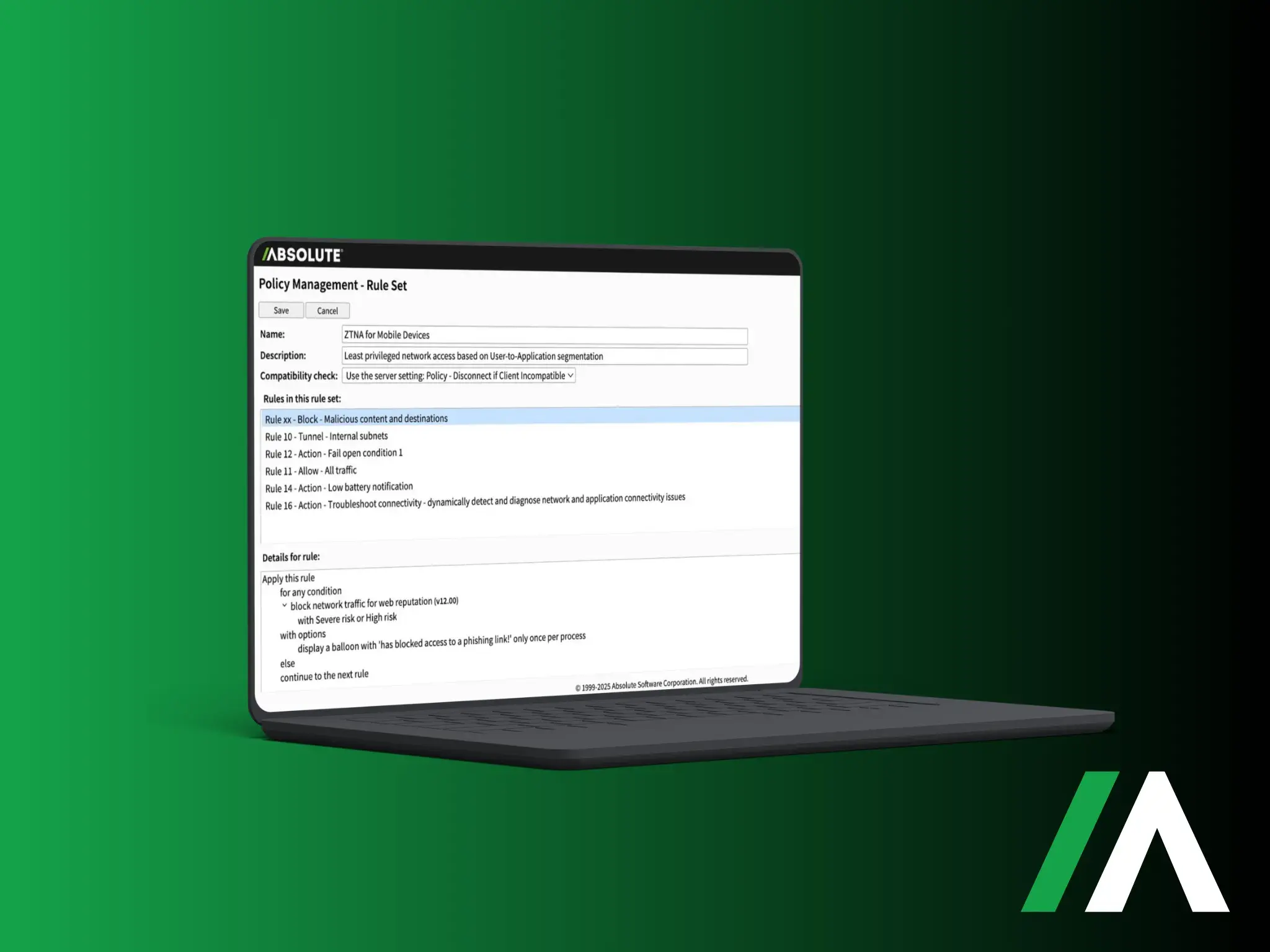
Absolute Secure Access is built around a different assumption than most of the platforms on this list: that VPN and ZTNA clients will eventually be tampered with, disabled, or accidentally removed, and the platform managing remote access needs to survive that, not just alert on it. The self-healing client can automatically repair or reinstall itself when something goes wrong, keeping the zero-trust policy enforced instead of silently failing open.
That's why Absolute was named a Leader in G2's Summer 2025 Grid Report for Zero Trust Networking and recognized among KuppingerCole's Leaders for ZTNA, with additional independent analysis available in 451 Research's report on building resilient zero trust. If your environment treats “can this policy survive a tampered client” as seriously as “can this policy enforce least privilege,” this is the strongest fit on this list.
Zscaler
Zscaler was named a Leader in both the 2026 Gartner Magic Quadrant for Security Service Edge and the 2026 Gartner Magic Quadrant for SASE Platforms, its fifth consecutive year as an SSE Leader. Its strength is operating at enormous scale as a pure cloud-native security stack. The trade-off is a platform built primarily around its own cloud, which can mean less flexibility for enterprises with significant on-premises infrastructure still in the mix.
Palo Alto Networks (Prisma Access)
Palo Alto Networks has been named a Leader in the Gartner Magic Quadrant for SSE for a fourth consecutive year, placed highest in Ability to Execute and furthest in Vision in the 2026 report. Prisma Access is the strongest fit for enterprises that want zero-trust access converged tightly with an existing Palo Alto Networks firewall and security operations investment, rather than managed as a standalone product.
Netskope
Netskope was named a Leader in both the 2026 Gartner Magic Quadrant for Security Service Edge, its fifth consecutive year, and the 2026 Gartner Magic Quadrant for SASE Platforms, where it was cited as highest in Ability to Execute. Its differentiator is depth of data protection and cloud application context layered into every access decision, making it a strong pick for data-centric enterprises prioritizing DLP alongside network access control.
Cloudflare (Cloudflare One)
Cloudflare was named the only Visionary in both the 2026 Gartner Magic Quadrant for SSE and the 2026 Gartner Magic Quadrant for SASE Platforms. Built on Cloudflare's globally distributed network, Cloudflare One packages zero-trust access alongside a broader set of connectivity and developer-facing services, a strong fit for fast-growing or mid-market enterprises that want one simple platform rather than a deep enterprise security stack.
Cisco (Secure Access / Duo)
Cisco is a named vendor in the 2026 Gartner Magic Quadrant for Security Service Edge. Its particular strength is for enterprises already standardized on Cisco networking hardware and Duo multi-factor authentication, where Secure Access integrates natively with infrastructure and identity tools already in place rather than requiring a separate, disconnected zero-trust layer.
Fortinet (FortiSASE)
Fortinet sits in the Challengers quadrant of the 2026 Gartner Magic Quadrant for SASE Platforms. FortiSASE is a strong option for budget-conscious or mid-market enterprises already running Fortinet firewalls, since it converges SASE capabilities into the same management console and licensing relationship those teams already maintain.
Best Zero-Trust Platforms by Use Case
The list above ranks these platforms broadly. In practice, the better question is usually narrower: which one fits your specific situation.
Best for Resilience-Critical Industries
Healthcare, financial services, and public safety organizations share a constraint most industries don't: downtime or a silently failed access policy isn't just costly, it can directly affect patient care, financial operations, or public safety response. Absolute Secure Access's self-healing client is built around that constraint specifically.
Best for Massive Global Scale
For enterprises operating at a scale where cloud-native inline inspection needs to run globally without friction, Zscaler's scale and maturity are difficult to match.
Best for Security-Stack Convergence
If your SOC and firewall investment is already built around Palo Alto Networks, Prisma Access converges zero-trust access into that same ecosystem rather than adding a disconnected layer.
Best for Data-Centric, DLP-Heavy Environments
Netskope's depth in data protection and cloud app visibility outperforms general-purpose SSE platforms for organizations where DLP is the primary driver.
Best for Simplicity and Mid-Market Speed
Cloudflare One's packaged simplicity suits fast-growing or mid-market enterprises that want one platform covering both connectivity and zero-trust access without a heavy enterprise rollout.
Best for Cisco-Standardized Enterprises
Enterprises already running Cisco networking and Duo MFA get the most native fit from Cisco's own Secure Access offering.
Best for Budget-Conscious, Fortinet-Standardized Enterprises
FortiSASE's tight bundling with Fortinet's existing firewall fleet makes it the most cost-efficient path for enterprises already standardized on that hardware.
How to Choose the Right Zero-Trust Platform for Your Enterprise
Start from what actually breaks today, not the longest feature list.
- If resilience and policy enforcement surviving a tampered or removed client is the gap, prioritize a self-healing platform over additional dashboards.
- If scale and global cloud-native inspection are the bottleneck, prioritize platforms built for that specific load.
- If your environment is already a single-vendor security ecosystem, the native platform for that ecosystem usually beats a standalone best-of-breed tool.
- If you're a lean IT team wanting one simple platform rather than a deep enterprise rollout, prioritize a converged, packaged option over a highly configurable one.
Enforce Zero-Trust with Absolute Security
The right zero-trust platform is the one that still enforces policy on the night a client gets tampered with, not just the one with the longest feature list on a sales call. For more on where common assumptions about secure access break down, see our related post, Debunking Myths About Secure Access Solutions.
To see how Absolute Secure Access's self-healing VPN and ZTNA client keeps your policy enforced no matter what happens to the device: schedule a 1:1 demo with our team today!